
Somewhere between twenty and two hundred employees, spreadsheets stop scaling. Sales, stock, invoicing, HR and projects need to share one source of truth. The question is usually the same: Odoo or custom ERP? Adopt a ready-made platform such as Odoo, or build software around how we work?
There is no universal answer, but there is a sensible way to decide. This guide gives you the questions, a decision tree and a scorecard.
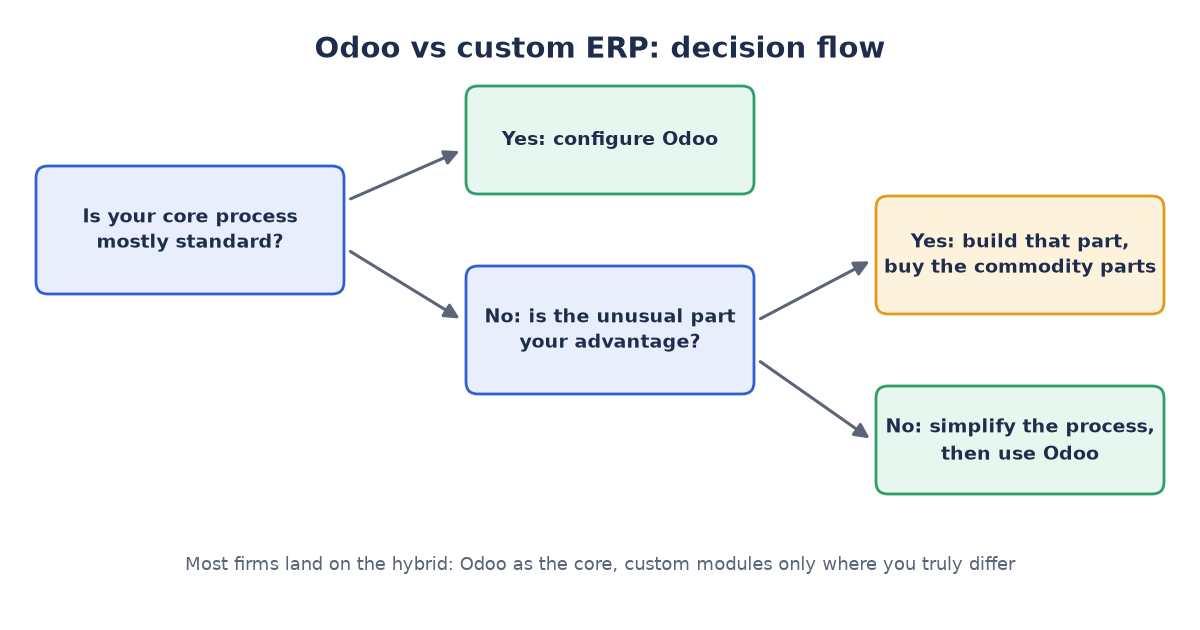
Figure 1: the Odoo or custom ERP decision flow.
Odoo or custom ERP: what you are actually choosing between
Odoo is a modular business platform. Its Community Edition is open source (LGPL); its Enterprise edition adds proprietary modules and is paid per user, and Odoo also sells hosted plans. You switch on the apps you need: sales, CRM, inventory, accounting, HR, recruitment, projects and more. Pricing is per user and varies by plan and region, so check the current figures on the Odoo pricing page instead of trusting a blog post, including this one.
A custom ERP is software built specifically for your processes by your own team or a partner. You own the design, and you also own the maintenance, security, upgrades and documentation.
There is also a third path, and it is often the right one: Odoo as the core, with custom modules and integrations where your process is truly different.
Seven questions to settle Odoo or custom ERP
- How standard is your core process? If you sell, buy, stock, invoice and hire like most companies, a platform already models it. If your core workflow is unusual and central to how you win, a platform may fight you.
- Is the unusual part a competitive advantage? If yes, build that part. If it is merely a habit, change the habit.
- How fast do you need to be live? A platform with standard configuration can be live in weeks to a few months. A custom ERP takes longer before it does anything useful.
- What does five years cost? Count licenses or hosting, implementation, customization, data migration, training, maintenance and upgrades, not just the first invoice.
- Who will own it? A custom ERP needs people who understand it for years. If those people leave, what happens?
- What must it integrate with? Payment gateways, e-commerce, government e-invoicing, legacy systems, factory machines. Check that integrations exist or can be built.
- What are your compliance and data rules? Local tax rules, localization, hosting location and audit trails can decide the question on their own.
An Odoo or custom ERP decision tree
- Is your core process mostly standard (sales, purchasing, inventory, accounting, HR)?
- Yes: go to question 2.
- No: go to question 4.
- Can you accept configuring a platform instead of redesigning it around you?
- Yes: Odoo (or a similar platform) is your default. Go to question 3.
- No: go to question 4.
- Are there two or three processes that genuinely differ?
- No: use Odoo as is.
- Yes: use Odoo and build custom modules only for those processes.
- Is the unusual process your competitive advantage?
- Yes: build that part as custom software, and still buy the commodity parts (accounting, HR, inventory).
- No: simplify the process and return to question 2.
- Can you fund and staff the software for five years or more?
- No: do not go fully custom. Choose a platform or a hybrid.
- Yes: custom can be justified.
A quick scorecard
Give each statement a score from 0 (not true) to 2 (very true).
| Statement | Points toward |
|---|---|
| Our process is similar to most companies in our sector | Odoo |
| We need to be live in under six months | Odoo |
| We have no in-house engineering team | Odoo |
| Our workflow is a real competitive advantage and very unusual | Custom |
| We have engineers who will own the system for years | Custom |
| We must integrate deeply with unusual legacy systems | Custom or hybrid |
| We have strict data-location or audit rules that platforms do not cover | Custom or hybrid |
Add the points for each side. A clear lead is a clear answer. A close score usually means the hybrid.
The hybrid path
A hybrid approach keeps Odoo as the system of record and builds on top of it:
- Custom modules for the few processes that differ.
- Integrations with the other systems you depend on.
- An automation or AI layer, for example assistants that draft replies, classify incoming requests or summarize records, working through the platform’s API with human approval.
The discipline is to customize as little as possible. Every custom change makes future upgrades more expensive.
Common mistakes
- Over-customizing a platform. The company ends up with a custom ERP that is also hard to upgrade.
- Choosing custom because “we are special”. Check the claim against what your competitors do with off-the-shelf tools.
- Skipping data migration planning. Cleaning and moving historical data is often the hardest part.
- No process owner. Software does not fix a process nobody owns.
- Training as an afterthought. Adoption decides whether the project pays back.
- Ignoring exit options. Ask how you would export your data and move away.
Before you decide
Write down your top ten processes, mark which are standard and which are unique, and estimate the five-year cost of each path. If you cannot do that yet, run a small, time-boxed pilot on one department before committing.
We help companies configure Odoo, extend it with custom modules and add automation on top.
Unsure whether Odoo or a custom build fits your company?
A short, honest second opinion can save a costly decision. Book a free 30-minute Odoo vs Custom ERP Review through our contact page and we’ll go through your top processes and the trade-offs. You can also email us at info (at) abcsoft (dot) digital.
Add a Comment