

Training junior developers is one of the first things a small company postpones, because it sounds expensive. Courses, conferences, a senior with nothing else to do: every version looks like a line item a ten-person team cannot justify. Our experience is the opposite. The parts of training junior developers that actually work cost attention, not money, and they fit inside the work you already do. Here is the system we recommend: a one-page skill map, small real tasks with real review, pairing rotations, short written notes, memory drills for onboarding facts, time-boxed mentors, and one honest check per month.
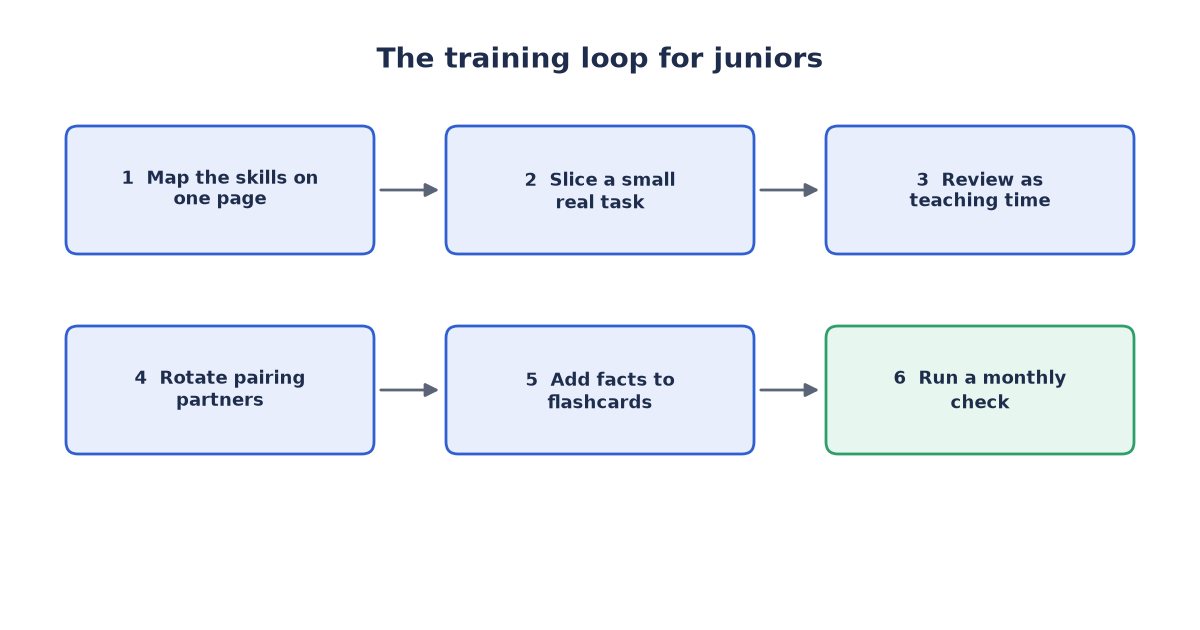
Figure 1: The training loop, from one-page map to monthly check
Why free courses alone are not a training plan
Free learning material is good at some things. The MDN learning area teaches web fundamentals in a structured way, at no cost, and public developer roadmaps lay out which topic comes before which. For coverage of syntax and core concepts, free resources are hard to beat.
What they cannot give a junior is feedback, context, and priorities. A course never reviews your code and never interrupts you when you are heading down the wrong path. There is also a deeper problem: beginners do not know what they do not know. We wrote before about the four stages of competence when learning to program, and the first stage is exactly this blind spot. A junior cannot pick their own curriculum, because picking requires the knowledge the curriculum should provide. That is why free material alone cannot carry a junior’s growth: it answers questions, but a beginner cannot yet ask the right ones.
| What a junior needs | Free resources | Guided practice |
|---|---|---|
| Coverage of fundamentals | Strong | Weak |
| Order of topics | Generic | Cut to your stack |
| Feedback on real code | None | On every task |
| Product context | Missing | Picked up daily |
| Progress you can see | Hard to judge | Shipped work |
Start training junior developers with a one-page map
One person drafts the map: the mentor, a founder, or the strongest engineer on the team. Take a public roadmap, cut it to what your product actually touches, and put it on one page: what a junior should be able to do, in rough order.
- The core of the language and its standard library
- The framework and data layer the product is built on
- Version control and the team’s review workflow
- Testing: what to test and how to read a failure
- How code reaches production, and how to ask for help early
Mark each line as needed in the first month, needed by month three, or later. The map is a working document, not a contract: the monthly check revisits it, and finished lines get crossed off. The point is not completeness; the point is that training junior developers has a direction, and both sides can tell whether progress is happening.
Small real tasks: the engine of training junior developers
Courses teach in a sandbox; teams teach through the backlog. The unit of training is not a lesson but a task: a real bug, a small feature, missing tests, a rough patch that needs tidying. Slice it so a junior can finish in hours, not weeks, with a definition of done agreed in advance. Invented exercises feel like school; a fix that ships feels like work and teaches like work.
The review is where the teaching happens, so protect it:
- Pick a task from the real backlog and slice it small.
- Agree, in one sentence, on what done means.
- The junior works in short stretches and asks questions early.
- The reviewer checks correctness first, style second, and explains the reasoning behind every change request.
- The junior applies the feedback and writes one takeaway note.
A reviewer who only says what to change wastes the moment; one who explains why turns a task into a reusable pattern. One rule is worth keeping: never let a release depend on a training task, so the pair can slow down.
Pairing rotations and time-boxed mentors
Pair programming is the fastest way to transfer judgment, the thing free material cannot teach. Short sessions beat marathon ones: forty-five to ninety minutes, a few times a week, junior at the keyboard, senior thinking aloud. Rotate the pairs. Rotations keep training junior developers from depending on one person’s calendar and mood, and they stop a single mentor from becoming a bottleneck.
Mentor time must be time-boxed, or it evaporates: two or three fixed slots a week, marked in the calendar. Add a question protocol: try for fifteen minutes, write down what you tried and where it broke, then ask. The written attempt turns interruptions into lessons and keeps senior time predictable. For distributed teams, our older post on tools for remote teams covers the plumbing: screens, sessions, boards.
Make facts stick and learning visible
Onboarding is full of arbitrary facts nobody remembers after one hearing: commands, conventions, quirks, who owns what. Spaced repetition, reviewing information at growing intervals, is a cheap fix with a long history. A shared flashcard deck, in a tool such as Anki, grows one card at a time: every convention asked about twice becomes a card. It is unglamorous, and it is the backbone of the whole system, because forgetting basics is what makes juniors feel stuck.
The second habit is writing. After every task, the junior writes a short note: what the problem was, what they tried, what they learned. Ten to fifteen lines is enough. The notes do three jobs: they force the junior to articulate the lesson, they build a searchable archive for everyone who joins later, and they give the monthly check something concrete to read.
A monthly check keeps training junior developers on track
Once a month, mentor and junior sit down with the notes, the map, and the task list. Not a performance review: a working session with four questions.
- Which tasks shipped, which stalled, and why?
- Which issue came up twice in review? That is a gap in the map.
- Which facts keep slipping? Those go into the flashcard deck.
- What blocked the junior most, and what changes next month?
Then update the map and pick the task slices for next month. The check is where all of this stops being a collection of good intentions and becomes a loop with feedback. It also protects the seniors: without a checkpoint, mentoring drifts and everyone concludes that juniors are not worth the effort.
The whole system in one line: a map, real tasks sliced small, review as teaching, rotating pairs, a shared flashcard deck, a note after every task, one monthly check. None of it costs money. All of it compounds.
Training junior developers without a budget is a design problem rather than a spending problem. Slice the work small, protect review time, rotate the pairs, write things down, and look at the result once a month. If you would like a second pair of eyes, we offer a free 30-minute review: tell us how your team works or write to info (at) abcsoft (dot) digital, and we will go through your map, tasks, and review habits, and suggest the first thing to change.
Add a Comment